What makes learning generalize?
Understanding how the information in demonstrations and learned representations affects behavior beyond the training distribution.
Generalization & learningRobot learning & machine learning
How do robots learn
to generalize?
I'm a PhD researcher in Mechanical Engineering at UC Berkeley, advised by Professor Masayoshi Tomizuka and affiliated with Berkeley Artificial Intelligence Research (BAIR). I expect to graduate in May 2027.

Our work on compositional generalization in sequential robot tasks is a CoRL 2026 Spotlight.
DADP is accepted at ICML 2026. I also received the ICML Gold Reviewer recognition.
Three papers at ICLR 2026: VER, Interleave-VLA, and Mean Flow Policy (Oral).
I joined Amazon as an Applied Scientist Intern, studying reusable action priors for data-efficient vision-language-action models.
Our robotic palletization paper received the Best Paper Award in Automation at ICRA 2025. Congratulations to Tianqi!
I joined NVIDIA as an Isaac Loco-Manipulation Intern.
Two papers got accepted by CVPR 2025!
One paper got accepted by CoRL 2024!
One paper got accepted by ECCV 2024!
One paper got accepted by IROS 2024!
01 Research perspective
I study efficient and generalizable robot learning, with work on model architectures, representation learning, data-centric policy learning, and the theory and acceleration of generative models.
Understanding how the information in demonstrations and learned representations affects behavior beyond the training distribution.
Generalization & learningLearning representations that retain useful structure, transfer across tasks, and connect perception to action.
Representation & transferExploring how modularity and generative models let policies reuse knowledge, adapt, and learn new skills.
Policy structure & adaptation02 Publications
Three threads connecting fundamental questions to learning in the physical world.
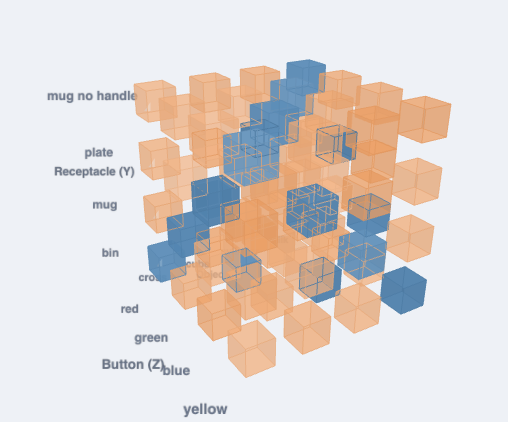
trained held out · darker = higher success
Derived an upper bound on the compositional generalization gap, decomposing it into marginal instruction shift, instruction compositional shift, and context-action shift.
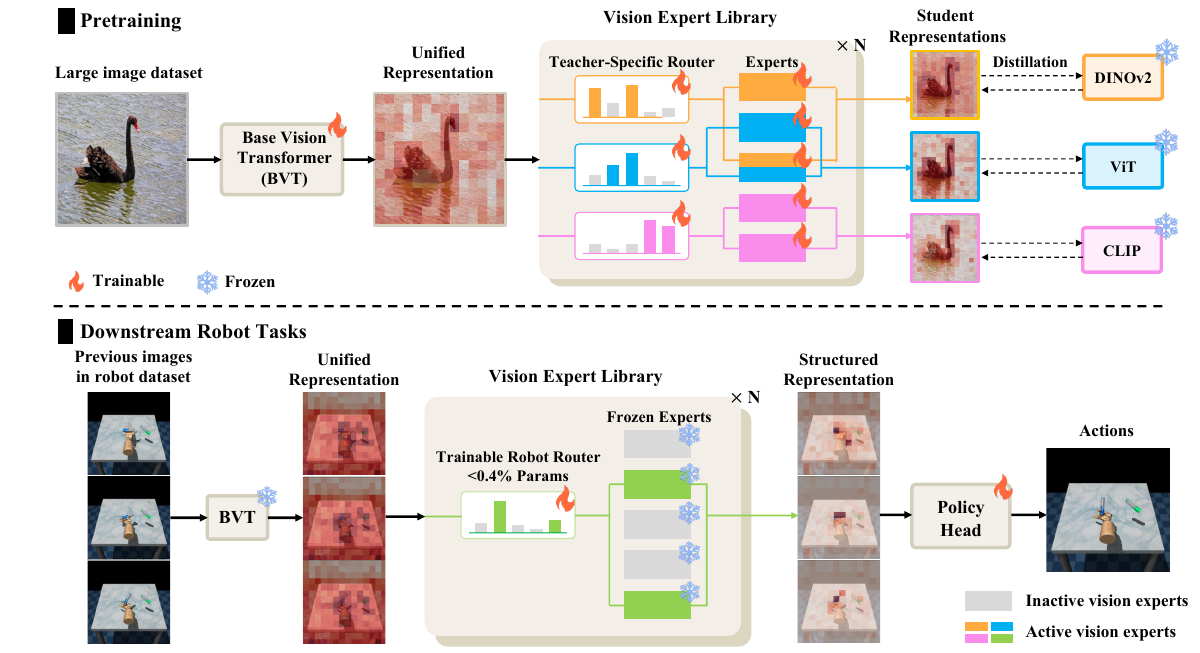
Modular visual encoder that distills knowledge from multiple vision foundation models into a reusable expert library and employs lightweight dynamic routing to select task-relevant visual representations.
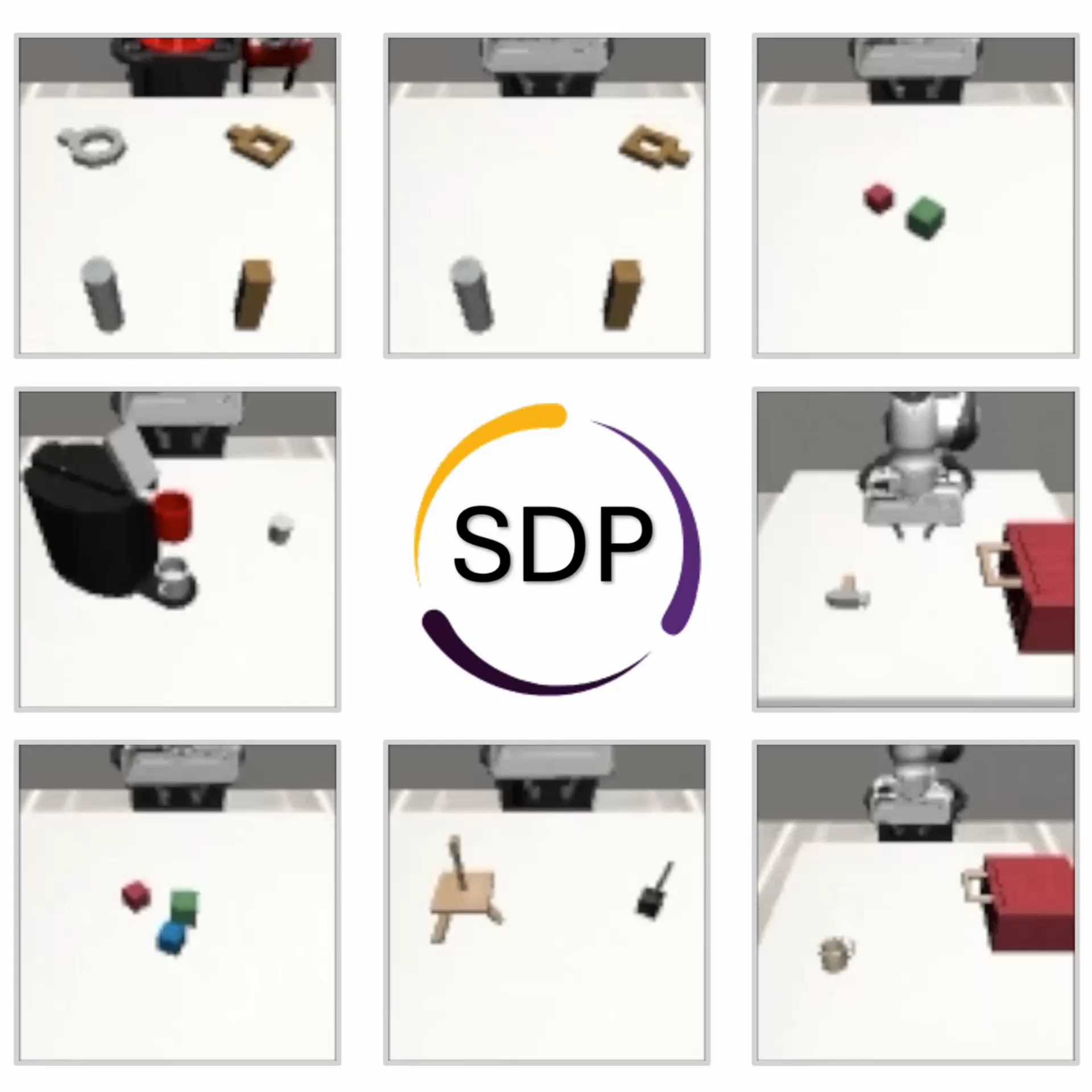
Unified robot model architecture based on a mixture of experts Transformer that enables specialized expert learning, selective expert activation, cross task knowledge reuse, and incremental expert expansion to support multitask learning, continual learning, and parameter efficient adaptation.
* Equal contribution. † Corresponding author.
2026ICML
2026ICLR
2026ICLR
2025CVPR
2025CVPR
2025ICRA
Best Paper Award in Automation
2025ICRA
2024ECCV
2024IROS
2026IEEE/ASME T-MechEarly access
2026ICRA Space Robotics Workshop
2026Preprint
2026Preprint
2026Preprint
2025Preprint
2024Preprint
2024Preprint
03 Beyond the papers
Pretrained reusable action priors through large-scale reinforcement learning to enable data-efficient training of vision language action models for dexterous manipulation.
Characterizes how data composition and scaling, training dynamics, and contrastive learning shape shared representations for policy transfer and generalization across human-robot embodiments.
PhD in Mechanical Engineering
MS in Mechanical Engineering
BS and MS in Mechanical Engineering
I review for ICML, ICLR, ICRA, and IROS, and for IEEE Transactions on Robotics (T-RO), IEEE Robotics and Automation Letters (RA-L), and Transactions on Machine Learning Research (TMLR).
ICML Gold Reviewer · 2026
Let’s exchange ideas
I am always open to collaboration and discussions on exciting research projects. Please feel free to reach out!