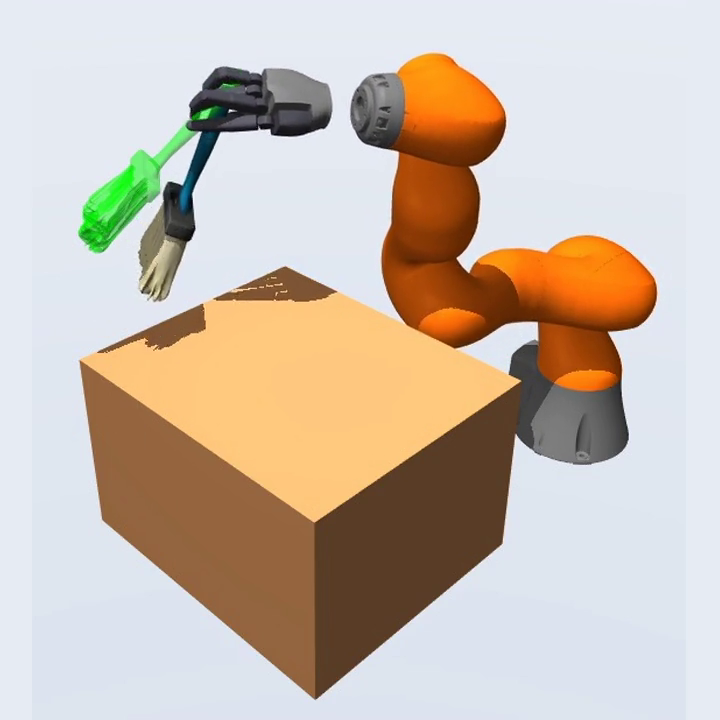
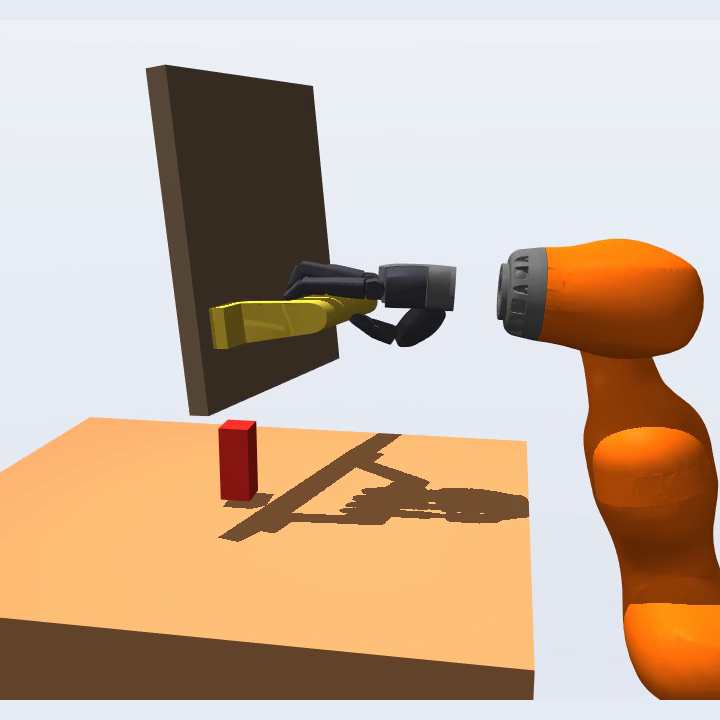
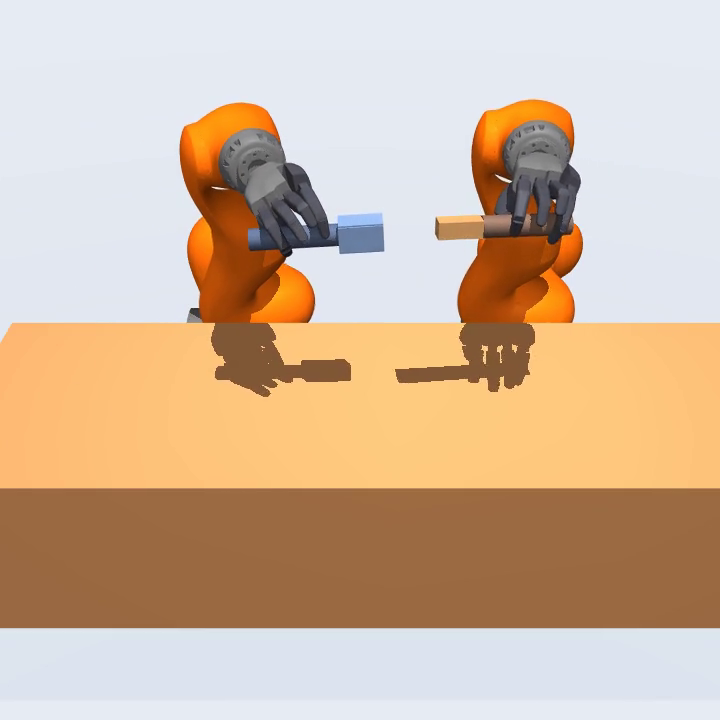
One action prior, pretrained once with reinforcement learning, is reused for three simulated downstream tasks. Images show collected demonstration trajectories.
01Overview
Reinforcement learning (RL) in simulation can acquire precise dexterous control, but it relies on
privileged state that is unavailable at deployment. Latent RL Prior distills large-scale RL rollouts into
a flow-matching action decoder, freezes it, and learns only a visual interface that maps
camera images to the decoder’s latent context, using demonstrated actions as the sole supervision.
10×
fewer demonstrations on door lifting: 50 vs. 500 for the full-data VLA baselines
5×
fewer demonstrations on bimanual assembly: 1,000 vs. 5,000 for the full-data VLA baselines
32.6%
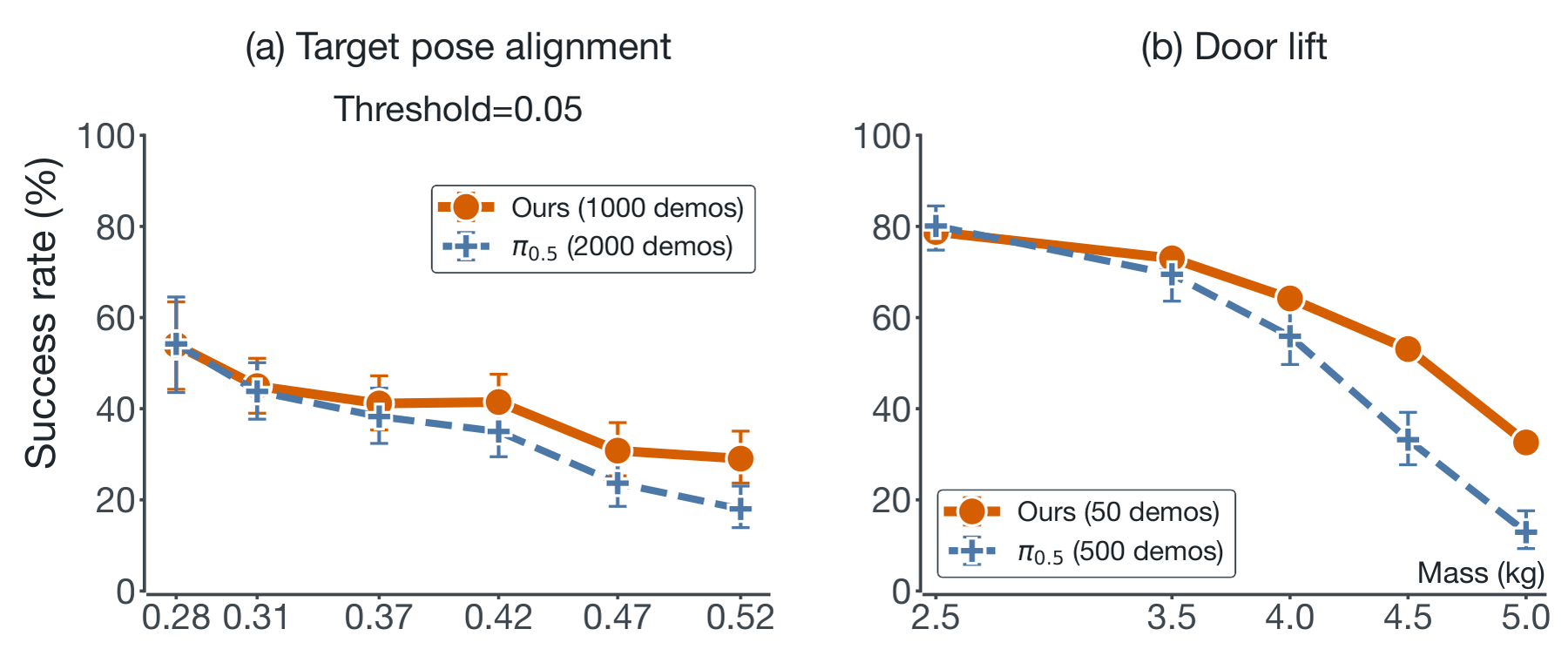
door-lifting success at an unseen 5.0 kg mass with 50 demos, vs. 12.9% for π0.5 with 500
8 / 8
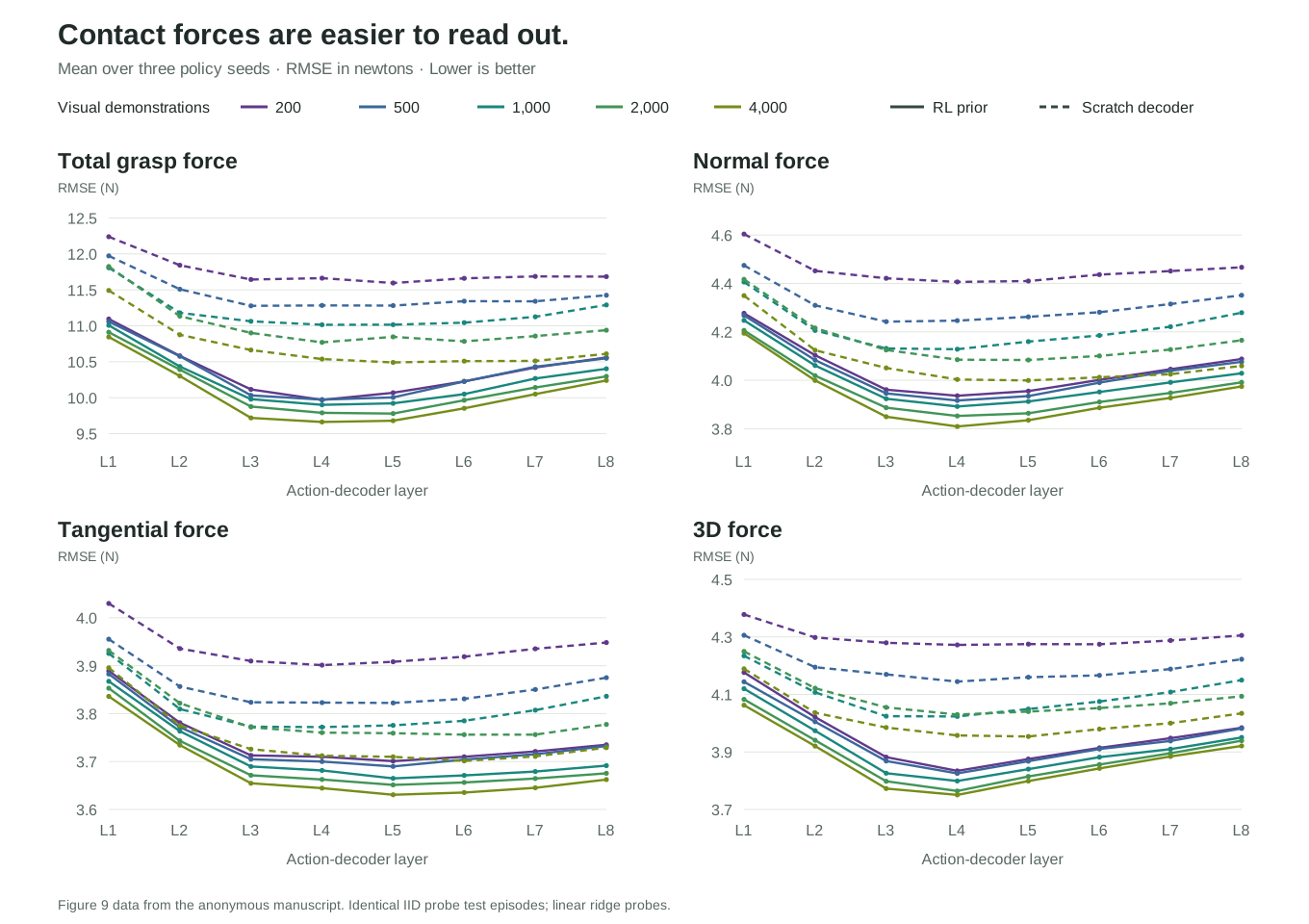
decoder layers with lower contact-force probe error than a scratch decoder, for every force target and budget
Baselines are full-parameter fine-tuning of π0.5 and GR00T N1.7. Efficiency refers to downstream
visual demonstrations; the action prior is pretrained on 100,000 successful simulated RL rollouts.
Abstract
Learning dexterous manipulation from limited visual demonstrations is challenging because policies must acquire both perceptual grounding and precise control, while reinforcement learning (RL) in simulation can acquire rich control behaviors from large-scale interaction with privileged information. We introduce Latent RL Prior, a two-stage framework that reuses this control knowledge for data-efficient visual policy learning. During privileged pretraining, we distill large-scale RL rollouts into a flow-matching action decoder conditioned on proprioception and latent task context. During visual adaptation, we freeze the decoder and learn a visual interface that maps images to its latent context using action supervision alone, without privileged labels or latent targets. The same decoder can further be shared across arms by learning coordinated visual contexts for bimanual manipulation. Across three simulated tasks, our method outperforms full-parameter fine-tuning of π0.5 and GR00T N1.7 in the low-data regime; on door lifting and bimanual assembly, it surpasses full-data baselines using 10× and 5× fewer demonstrations, respectively. Further analysis shows that direct visual-to-latent conditioning improves adaptation performance and training stability over routing visual predictions through the pretrained state encoder. Robustness to unseen mass variation and greater linear accessibility of contact-force information in decoder representations further provide evidence of retained RL-acquired control knowledge.
Contributions
A transfer framework. A frozen RL action prior is adapted through latent visual conditioning with action supervision alone, and a single-arm decoder is reused for bimanual manipulation.
Demonstration efficiency. Improved visual-demonstration efficiency on three dexterous tasks, with evaluations of the transfer interface and of which modules to adapt.
Evidence of retained control knowledge. Behavioral and representational analyses of robustness to object mass and of contact-force accessibility after visual adaptation.
02Method
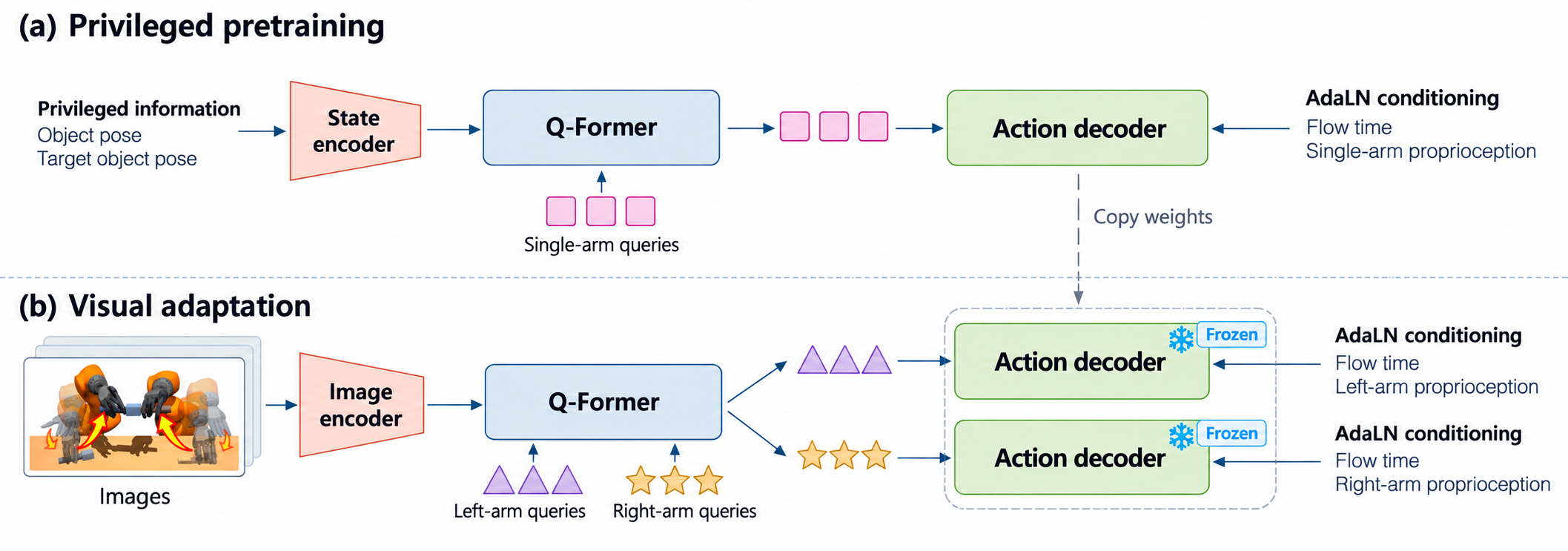
Training has two stages that share one action decoder. Task context reaches the decoder through cross-attention,
while proprioception and flow time enter through adaptive layer normalization (AdaLN). The source of the context can
therefore change from privileged state to images while the pretrained proprioceptive processing and action generation
stay intact.
Figure 1. (a) Privileged pretraining: a state tokenizer and Q‑Former supply task context to an action decoder conditioned on flow time and single-arm proprioception. (b) Visual adaptation: an image encoder and Q‑Former learn context tokens while the decoder remains frozen. For bimanual assembly, left- and right-arm queries interact within the same Q‑Former; each output group conditions the shared decoder with its arm’s proprioception.
Stage 1
Privileged pretraining
An RL teacher, fine-tuned from the released SimToolReal checkpoint on procedural pose alignment with randomized object shape, size, and density, provides 100,000 successful rollouts.
A state tokenizer and Q‑Former map the privileged history to latent context tokens. A transformer action decoder cross-attends to them and is trained with conditional flow matching.
Trained
state tokenizer, state Q‑Former, action decoder
Stage 2
Visual adaptation
The action decoder is frozen. A DINOv2 image encoder and a visual Q‑Former map camera images directly to the decoder’s context tokens (latent transfer).
Training uses the same flow-matching action loss: no privileged-state labels, no latent targets, and no trajectories paired with the RL data.
Trained
image encoder, visual Q‑Former
Frozen
action decoder
Extension
Two arms, one prior
Each arm receives its own group of queries. Both groups are processed jointly by one visual Q‑Former, so self-attention can coordinate the arms.
The same frozen single-arm decoder then generates each arm’s actions from that arm’s context and proprioceptive history.
Trained
image encoder, joint visual Q‑Former
Frozen
shared single-arm decoder
Change the context source; keep the decoder
Pretraining:Zt = Qψ(Tη(Pt))
Adaptation:Zt = Qϕ(Evis(It))
Shared decoder:vθ(Atτ, τ, Zt, Rt) ≈ At1 − At0
Pt: privileged history · It: image history · Rt: proprioceptive history · At: action chunk · τ: flow time. The decoder vθ is trained in stage 1 and frozen afterwards.
03Experimental Setup
All experiments run in MuJoCo Warp with KUKA iiwa arms and SHARPA dexterous hands. A single pretrained action
decoder is reused for every downstream task.
Figure 2. Left: the pretraining task, target pose alignment with varied procedural objects (inset: example templates). Right: the downstream tasks, target pose alignment with a held-out brush, door lifting, and bimanual assembly. The same pretrained action decoder is reused for all three.
Downstream tasks
Single arm · Unseen object
Target pose alignment
Pick up an unseen brush and match its target pose.
Grasp→Reorient→Align
Success criterion.All four object–target keypoint distances must be within 1.5 cm (strict) or 5 cm (relaxed) for 10 policy steps, not necessarily consecutive.
Videos replay collected demonstration trajectories in simulation; they are not closed-loop evaluations of the adapted policy. Download this video
Datasets
Table 1. Datasets for privileged pretraining and visual adaptation.
Dataset
Episodes
Arm–hand
Cameras
Pretraining
100,000
single
– (privileged state)
Target pose alignment
4,000
single
F, S, H
Door lifting
500
single
F, S, H
Bimanual assembly
5,000
bimanual
F, HL, HR
F: front, S: side, H: in-hand (L/R: left/right). Only the pretraining rollouts contain privileged information; the visual datasets do not. Downstream demonstrations come from a separate SAPG policy trained for each task.
Baselines and protocol
VLA baselines. Full-parameter fine-tuning of π0.5 and GR00T N1.7 for 30,000 steps with their officially recommended hyperparameters.
Ablations. The same visual architecture trained from scratch (no RL prior), and explicit transfer through the pretrained state encoder.
Ours. Latent transfer with a DINOv2-Small (ViT-S/14) image encoder, trained for 100,000 steps.
Evaluation. Checkpoints every 5,000 steps; the final five are evaluated on held-out environment seeds with 256 rollouts each. Each run reports its best of the five; results are mean ± std over three training seeds.
04Main Results
Does the RL prior reduce the number of visual demonstrations needed?
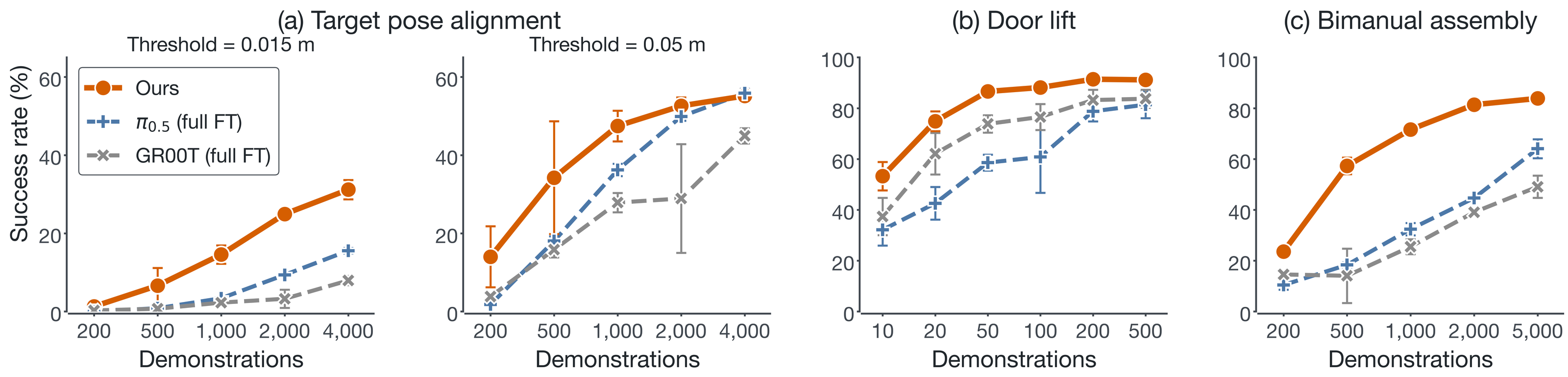
Figure 4. Comparison with full-parameter fine-tuning of GR00T N1.7 and π0.5 across demonstration budgets. (a) Target pose alignment at strict (ε = 0.015 m) and relaxed (ε = 0.05 m) thresholds; (b) door lifting; (c) bimanual assembly. Mean and standard deviation across three random seeds.
Door lifting
50 vs. 500
With 50 demonstrations, our policy outperforms both VLA baselines trained on the full 500-demonstration dataset.
10× fewer demonstrations
Bimanual assembly
1,000 vs. 5,000
With 1,000 demonstrations, the shared single-arm prior surpasses both full-data baselines on a two-arm task.
5× fewer demonstrations
Target pose alignment
ε = 1.5 cm
Higher success at every budget under the strict threshold. Under the relaxed 5 cm threshold the gap narrows with more data, becoming comparable to π0.5 at 4,000 demonstrations.
Largest gains for precise control
Takeaway: The RL prior helps most when visual demonstrations are scarce or the task demands precise control.
05Analysis
Where does the gain come from, how should vision access the prior, and what does the prior retain after adaptation?
A1Latent vs. explicit transfer
How should visual observations connect to the frozen prior?
Latent transfer maps image features directly to the decoder’s context tokens. Explicit transfer
instead predicts a privileged-shaped state and routes it through the frozen pretrained state encoder. Both use
action-only supervision.
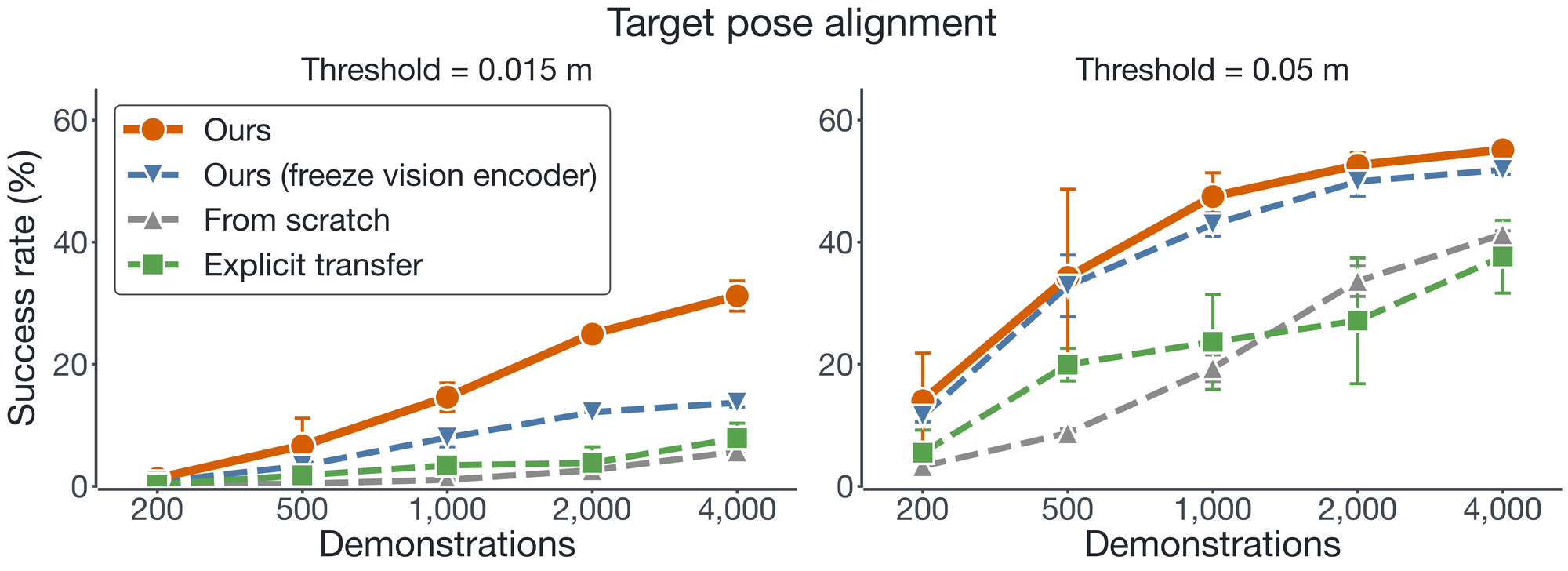
Figure 5. Target pose-alignment ablations with the action decoder frozen for both latent-transfer variants. Mean and standard deviation over three random seeds, except explicit transfer, which uses five.
With the image encoder frozen, latent transfer beats the same architecture trained from scratch at every budget and threshold, so the gain cannot be explained by better visual features learned during adaptation. This supports the pretrained action prior as a key source of the data efficiency.
Latent transfer clearly outperforms explicit transfer across budgets under both thresholds.
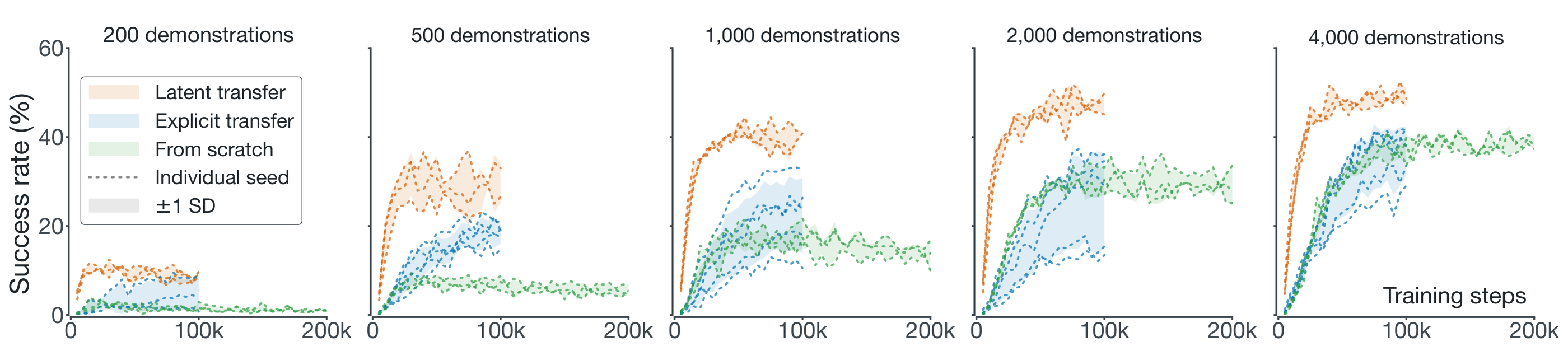
Figure 6. Training stability on target pose alignment at the relaxed (ε = 0.05 m) threshold, with the image encoder frozen. Dotted curves are individual runs; shaded regions are mean ± one standard deviation. Explicit transfer uses five seeds; latent transfer and scratch training use three each.
Takeaway: Reusing the prior depends on how vision interfaces with it. Conditioning the decoder’s latent context directly gives higher success and more consistent training than explicit transfer.
A2What to adapt
Which modules should change during visual adaptation?
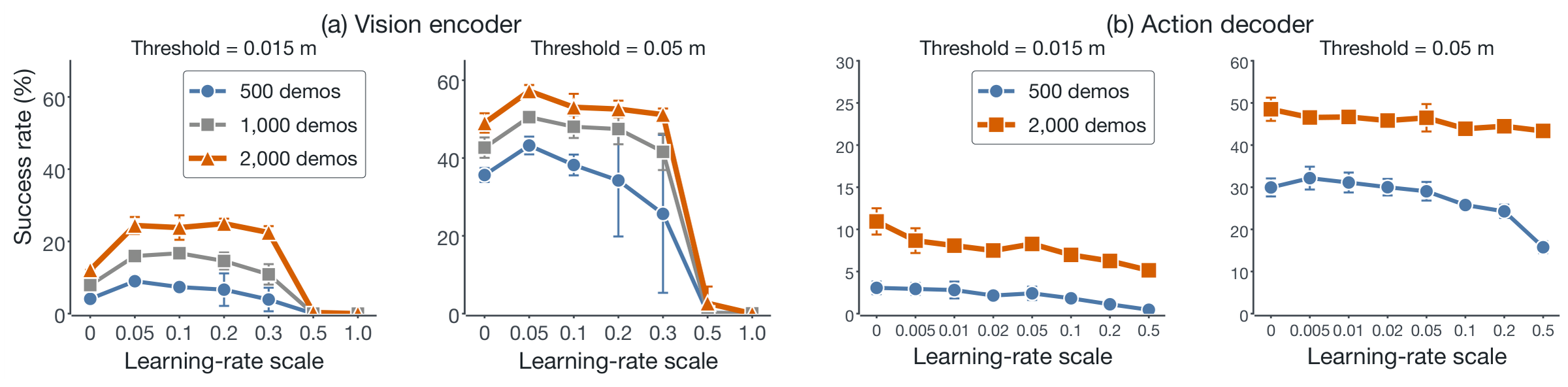
Figure 7. Learning-rate ablations for (a) the image encoder with the action decoder frozen and (b) the action decoder with the image encoder frozen, at strict and relaxed pose-alignment thresholds. Each scale multiplies the module’s original learning rate; zero freezes it. Mean and standard deviation across three seeds.
Conservative image-encoder updates improve strict success at every budget, while large updates degrade it, most strongly with 500 demonstrations.
Fine-tuning the action decoder brings no benefit at any tested scale; keeping it frozen is best under the strict criterion.
Takeaway: Adapt the image encoder conservatively and keep the action decoder frozen.
A3Robustness to unseen object mass
Does robustness acquired during RL pretraining survive visual adaptation?
RL pretraining randomizes object density, whereas each visual dataset contains a single object mass. Policies are
evaluated on heavier objects without further training.
Figure 8. Generalization to increased object mass. (a) Target pose alignment at the relaxed threshold: ours with 1,000 vs. π0.5 with 2,000 demonstrations. (b) Door lifting: ours with 50 vs. π0.5 with 500. The leftmost point is the reference mass used for visual training.
Door lifting at 5.0 kg
Ours 50 demos32.6%
π0.5 500 demos12.9%
Both methods perform similarly at the reference mass.
Takeaway: As mass increases, the RL-prior policy degrades more gradually than π0.5, despite using fewer demonstrations.
A4Contact-force information in the decoder
Do the decoder’s representations retain physical information learned through RL?
Linear ridge probes predict contact forces from the hidden state of each decoder layer of the adapted pose-alignment
policy, using a separate force-annotated dataset. Lower RMSE means the force information is more linearly accessible.
The comparison is a decoder of the same architecture trained from scratch.
RL prior (frozen, pretrained) Scratch decoderLower is better
Inspect a layer
2004,000
Layer 4 · probe RMSE
RL prior— N
Scratch decoder— N
Figure 9 data: mean over three policy seeds on identical IID probe test episodes; RMSE in newtons. Both policies fine-tune the image encoder at 0.2× its base learning rate for 100k steps. The vertical scale is fixed within each force target.
Figure 9. Linear contact-force probes, redrawn as vector graphics from the numerical results. Solid: RL prior; dashed: scratch decoder. Mean over three policy seeds.
Takeaway: Contact forces are more linearly decodable from the RL-prior decoder at every layer and budget. With 200 demonstrations, it already matches or outperforms the scratch decoder trained on 4,000.
The mass and force analyses are consistent with retained control knowledge from RL pretraining; they do not isolate a causal mechanism for the demonstration-efficiency gains.
06Limitations
The results concern downstream visual-demonstration efficiency, not total data or compute: the method relies on a capable privileged teacher and substantial simulated experience.
The frozen prior may inherit the teacher’s failure modes and restrict adaptation when new tasks require different control behaviors.
All tasks use the same arm–hand system. Bimanual transfer reuses the single-arm decoder and does not establish transfer to other robot morphologies.
Evaluation, including visual demonstration collection, is entirely in simulation; physical-robot performance is untested.
Mass robustness and force readout support the proposed interpretation but do not isolate a causal mechanism.
Code · planned releaseTraining and evaluation codeWill be released, as stated in the manuscript. The link will appear here.
Data · planned releaseDatasetsWill be released, as stated in the manuscript. The link will appear here.
08Citation
If you find this work useful, please cite it. This entry will be replaced with the arXiv citation once the paper is posted.
@misc{wang2026latent,
  title  = {Latent RL Priors for Data-Efficient Dexterous Manipulation},
  author = {Yixiao Wang and Peiyi Chen and Mustafa Mukadam and
            Shreekant Gayaka and Masayoshi Tomizuka and Son Tran},
  year   = {2026},
  note   = {Preprint; arXiv version forthcoming}
}