Experiments
Q1: Does the robot need to be trained on every task?
In Pick-Place-Press, one instruction means: pick one of 4 objects, place it in one of 4 receptacles, press one of 4 buttons. That is 4 × 4 × 4 = 64 possible instructions.
We train on B of them and test on all 64. The other 64 − B are held out: the same skills, in a combination never shown. Held-out success climbs steeply with B, then plateaus at B = 16 — a quarter of the set is enough.
And which 16 matters. The orthogonal 16 on the left covers every pair of ingredients exactly once, and reaches that plateau by itself.
Left: how the orthogonal 16 is built. Right: success vs. B for training sets drawn at random from the 64 · open standalone ↗
The orthogonal 16
One row per instruction. Every value appears 4 times down a column, and every pairing across any two columns appears exactly once — nothing repeated, nothing missing.
Success rate vs. B
Takeaway: Full coverage is unnecessary — and a well-chosen quarter of it is worth far more than a random quarter.
A rollout is one simulated attempt, scored success or failure. Each point pools all rollouts over 3 training seeds × 3 random draws of the B training instructions; the band is ±1 standard error across those draws (B=4 is a single fixed set, so it has no band). The star is the orthogonal 16 over 3 seeds. The grid is a design diagram, not measured data.
Every task, one at a time
Open full screen ↗The curves average over instructions; this view breaks that average open. Each small cube is one of the 64, placed by its object, receptacle and button. Pick a training set, then rotate and hover to see how each one did.
Q2: What Is Missing When Sparse Coverage Fails?
Diagonal pretraining learns reusable subtask skills but not instruction steering. Finetuning with only one demonstration per task improves OOD success from 0.4% to 54.7%.
OOD = tasks never seen during pretraining · +1 demo/instruction = one demonstration for each of the 64 task instructions · open standalone ↗
OOD Success: Before vs. After 1-Demo Finetuning
L5 Pick & Place (64 tasks) — pretrained on B sparse diagonal tasks, then finetuned with 1 demo per instruction
Takeaway: Even with as few as 4 pretraining tasks, one demonstration per instruction is enough to jump from near-zero to >50% OOD success — the skills were already there.
* B=8 baseline uses a single-seed evaluation (no 3-seed pooled baseline available for that checkpoint).
Q3: What Coverage Is Needed for Dependent Instructions?
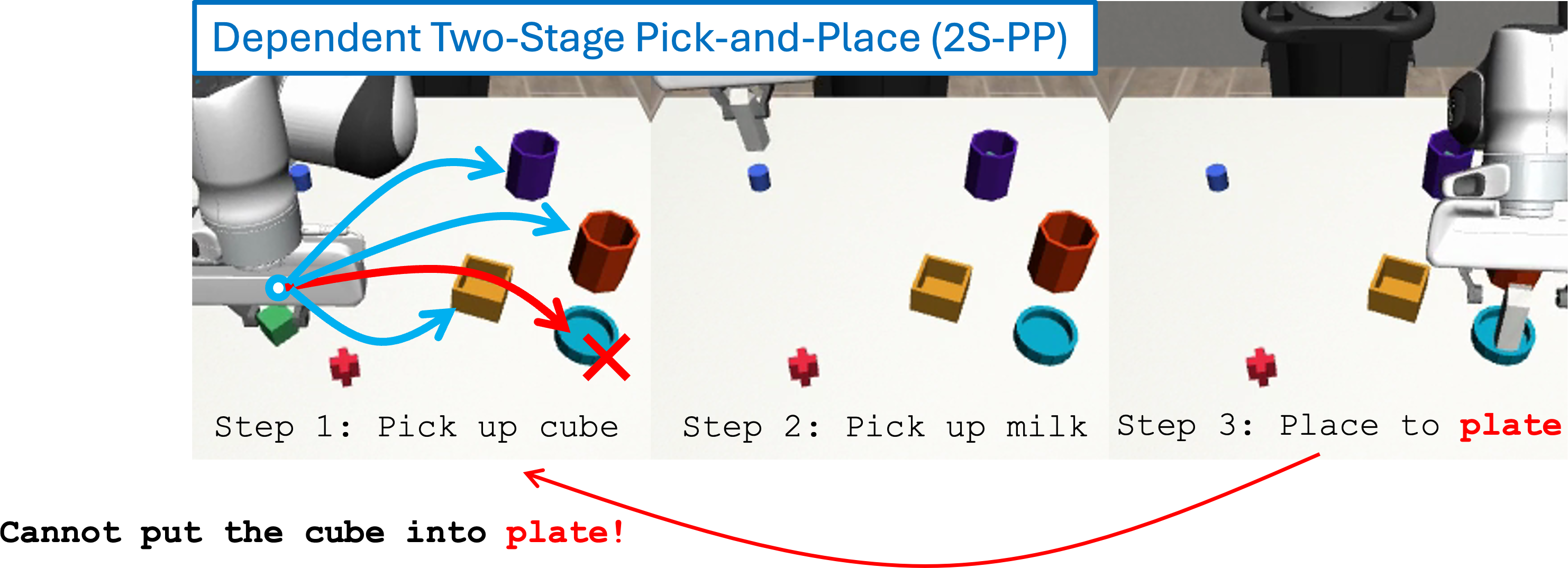
Now the two halves of the instruction depend on each other: the robot is told where the second object goes, and must infer where the first one goes.
Dependent Two-Stage Pick-and-Place · 48-task space · every condition trained on B = 16 tasks · open standalone ↗
The task
“Put the cube away, then put the milk on the plate.” Where the cube goes is never stated — but the plate is reserved for the milk, so the cube may go anywhere except the plate.
What training saw, and what it cost on held-out tasks
A task is an (o1, o2, c2) triple: 4 × 3 × 4 = 48 tasks, spanning 16 (o1, c2) combinations. Every combination in training demonstrates all 3 legal c1 — the rule is always fully shown. Crucially, all four conditions train on the same budget of 16 tasks — what changes is only how widely those 16 are spread over combinations, from 6 up to all 16. Coverage, not data volume.
At a fixed 16 training tasks, spreading them wider lifts held-out success 9.2% → 31.4% — no extra data, just better coverage. Seeing the rule in full is not enough; it has to be seen across combinations.
The board's counts and forbidden slots are exact. Which cells a condition covers is illustrative — the logs record how many, not which.
48-task Dependent 2S-PP (l4_2s_no_cont0, 48-task set). Mean ± SE across 5 training seeds, on the 32 held-out tasks. Cov6/9/12 are the B16 runs and Cov16 is the orthogonal 16-task design, so the training budget is 16 tasks in all four conditions — only coverage differs. Training on all 48 tasks is not shown: that run has no held-out split to measure.